~ $ cd projects/rocinante && cat README.md
A relativistic rocket
A ship that can keep its engine burning does not fly the way a probe does. It speeds up to halfway, turns round, and slows down the rest. Near the speed of light its own clock falls behind the ones at home, so a trip has two lengths. Here they are side by side, for one ship, to ten places:
$ rocket
| to | distance | on board | at home | top speed | fuel burnt |
|---|---|---|---|---|---|
| the Moon | 384,400 km | 6.3 hours | 6.3 hours | 34 km/s | 9.3 t |
| Mars | 0.52 au | 3.8 days | 3.8 days | 478 km/s | 133 t |
| Jupiter | 4.2 au | 11 days | 11 days | 1,360 km/s | 376 t |
| Saturn | 8.5 au | 15 days | 15 days | 1,934 km/s | 533 t |
| Pluto | 38.5 au | 32 days | 32 days | 1.4% of c | 1,123 t |
| Proxima Centauri | 4.24 light-years | 65 years | 65 years | 6.6% of c | all 5,000 t, then coasts |
| Sirius | 8.58 light-years | 131 years | 131 years | 6.6% of c | all 5,000 t, then coasts |
| Epsilon Eridani | 10.52 light-years | 160 years | 161 years | 6.6% of c | all 5,000 t, then coasts |
| Tau Ceti | 11.91 light-years | 182 years | 182 years | 6.6% of c | all 5,000 t, then coasts |
| the centre of the galaxy | 26,000 light-years | 395,840 years | 396,693 years | 6.6% of c | all 5,000 t, then coasts |
| Andromeda | 2.5 million light-years | 38 million years | 38 million years | 6.6% of c | all 5,000 t, then coasts |
To Proxima Centauri: speed against the ship's clock
The map is the neighbourhood: every star within twelve light-years of the Sun, each on a stem down to the plane of the celestial equator, so that the eye can tell above from below. Drag it to turn it. The ship flies the chosen trip over and over with its two clocks beside it — watch them part when the ship is fast. Press a row of the table, or a ringed star, to fly there.
The ship it opens with is a fusion torch: thirty thousand tonnes, a sixth of it fuel, a third of a g.
Things to try
- It owns the solar system and nothing else. Mars in under four days, Pluto in a month, on a little over a thousand tonnes of fuel. Proxima Centauri takes sixty-five years: in the first eleven weeks it burns a little more than half its fuel, keeping just enough to stop, reaches 7% of the speed of light, and coasts with the engine off for sixty-four years. At that speed the two clocks still agree.
- Give it fuel. Slide it up until the row for Proxima stops saying coasts: twenty ships' worth of fuel for every ship. The trip drops to seven years on board and eight and a half at home. This is the rocket equation: fuel has to carry the fuel.
- Make it perfect: exhaust at 100% of c, one g, and all the fuel the slider has. Now the clocks part. Proxima is 3.5 years on board and 5.9 at home. The centre of the galaxy is 20 years on board and 26,002 at home, and Andromeda is 29. You could go, inside a working life; nobody you knew would hear of it. The fuel for Andromeda is six million million ships for every ship, with an engine nobody knows how to build.
- Go where Project Hail Mary goes. Tau Ceti is 11.9 light-years away. With the perfect engine at one g it is 5.1 years on board and 13.7 at home. Turn the acceleration up and see how little it buys at home, and how much on board.
What it is not
Straight lines from a standing start, and star positions good to a picture, not to a navigator: no orbits, no launch windows, no gravity wells, and the planets are taken at the gap between their orbit and ours. No shielding either, and at these speeds the thin gas between the stars arrives as hard radiation. The arithmetic is the relativistic rocket of the Usenet Physics FAQ, and its table of trips at one g is what this page's tests are checked against.
Where it comes from
This is the arithmetic of the Rocinante Simulator, which I built in October 2025: the solar system and the thirty nearest stars in three dimensions, a ship to configure, and a sphere showing how far it can reach. Go there to fly it. This page keeps only the sums, written again for this site with nothing underneath.
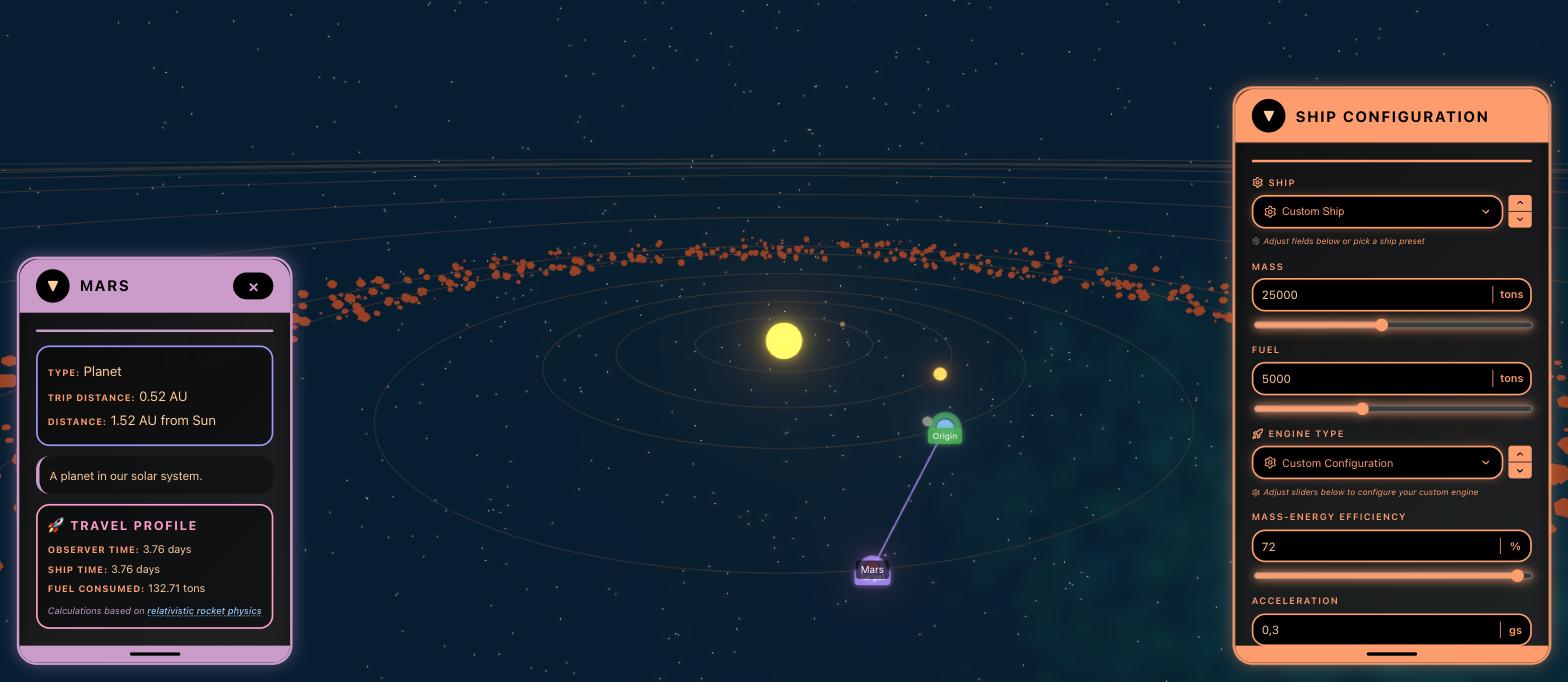
Its Mars is this page's Mars: the same ship, 3.76 days and 133 tonnes.
The two books behind it
The name is the ship of The Expanse, the novels of James S. A. Corey, the pen name of Daniel Abraham and Ty Franck, which begin with Leviathan Wakes in 2011, and the television series made of them. The Rocinante is named after Don Quixote's horse. What makes that universe possible is the Epstein drive, which keeps up a steady thrust on almost no fuel. This page is what the rocket equation says when there is no Epstein drive.
Project Hail Mary, Andy Weir's novel of 2021, filmed in 2026, sends its ship to Tau Ceti on an engine fed by Astrophage, single-celled organisms that take in light and give it out again. Its story turns on the two clocks this page keeps apart: the years its crew lives through are not the years that pass at home.